



California property managers must reconcile trust accounts monthly using the three-way method: matching the bank statement, the client ledger, and the total of all individual tenant balances. OJO Bookkeeping offers management bookkeeping services and cleanup work. The California Bureau of Real Estate mandates separate trust accounts for all security deposits and rents collected.
Key Takeaways
- California property managers must reconcile trust accounts monthly using the three-way method matching the bank statement, the trust account ledger, and the sum of all individual owner or tenant sub-ledgers.
- – The DRE requires property managers to keep the complete paper trail proving every transaction for a specified period.
- Three-way reconciliation matches the bank statement, the trust account ledger, and the sum of all individual owner or tenant sub-ledgers to the cent.
What Is California Trust Fund Accounting?
California trust fund accounting is the systematic process of recording, tracking, and reporting every dollar that moves through a trust account on behalf of property owners and tenants. The discipline answers one question at any moment: whose money is this, and exactly how much of it is there?
Trust accounts keep owner and tenant funds separate from business operating money. Rent checks, security deposits, and maintenance reserves do not belong to the property management firm. They belong to clients. California DRE trust fund accounting rules enforce this separation with zero tolerance for commingling. A property manager who mixes client funds with corporate operating cash violates state regulations immediately.
The stakes are severe. Mishandling trust funds destroys an owner’s trust, triggers lawsuits, and costs brokers their licenses entirely. No second chances exist once funds are commingled.
How Does Trust Accounting Differ From Standard Business Accounting?
Standard business accounting tracks money the company owns. Trust accounting tracks money the company holds for others. The distinction is legal, not just procedural.
Separation is mandatory. Property managers never mix business operating funds with client funds, including rent, deposits, and reserves. Each trust account must reflect exactly which owner or tenant owns every cent at all times. A standard business ledger cannot provide this level of granularity.
What Triggers a Property Management Trust Account Audit?
A property management trust account audit typically begins when the California Department of Real Estate (DRE) identifies irregularities during a routine examination or complaint investigation. Auditors demand a complete three-way reconciliation matching the bank statement, the trust ledger, and individual owner or tenant sub-ledgers to the penny.
Failure to produce this reconciliation on demand signals deeper compliance failures. The DRE treats unreconciled trust accounts as evidence of potential misappropriation. Property managers who maintain audit-ready books avoid the cascading consequences of a failed examination, including license suspension and mandatory restitution proceedings.

What Are California DRE Trust Fund Accounting Rules?
California DRE trust fund accounting rules govern how property managers handle money that belongs to owners and tenants. The California Department of Real Estate (DRE) enforces these rules under California DRE trust fund accounting statutes, specifically BPC § 10145 and Regulations 2831, 2831.1, and 2832. Trust account compliance runs on three separate rules: how fast client money must move into the account, how often reconciliation must occur, and how long the paper trail must be preserved.
How Quickly Must Client Funds Be Deposited in California?
Timelines are tight. While laws vary, many states require deposits within three banking days. California’s rules are strict, and they vary depending on where a property sits. A property manager handling funds in Los Angeles faces the same statutory urgency as one operating in San Francisco. Delayed deposits create immediate compliance exposure.
What Reconciliation Standards Does the California DRE Require?
The DRE mandates regular three-way reconciliation of trust accounts. This process matches the bank statement, the general ledger, and individual tenant ledgers to confirm every dollar is accounted for. Discrepancies left unresolved for even one reporting cycle signal deeper recordkeeping failures. A property management trust account audit by the DRE examines these reconciliations first. Auditors look for precise, timely matching across all three records.
How Long Must Trust Account Records Be Retained?
Record retention forms the third pillar of compliance. Destroying records early eliminates the only defense available during an audit or owner dispute. The retention clock starts from the date of the transaction, not the end of the management contract.
How Does Three-Way Reconciliation Work?
Three-way reconciliation matches three independent financial records to confirm every dollar is accounted for. The process answers one question at any moment: whose money is this, and exactly how much of it is there? A property manager holding tenant security deposits and owner rent proceeds must prove that bank balances, software ledgers, and general ledger entries all tell the same story. Miss a step, and the consequences include a state audit, license suspension, or worse.
What records are compared during three-way reconciliation?
The process compares the bank statement, the property management software ledger, and the general ledger. Each record serves a distinct purpose. The bank statement shows actual cash movement. The software ledger tracks individual owner and tenant balances. The general ledger provides the accounting system’s official record. All three must align to the cent.
How do property managers perform three-way reconciliation step by step?
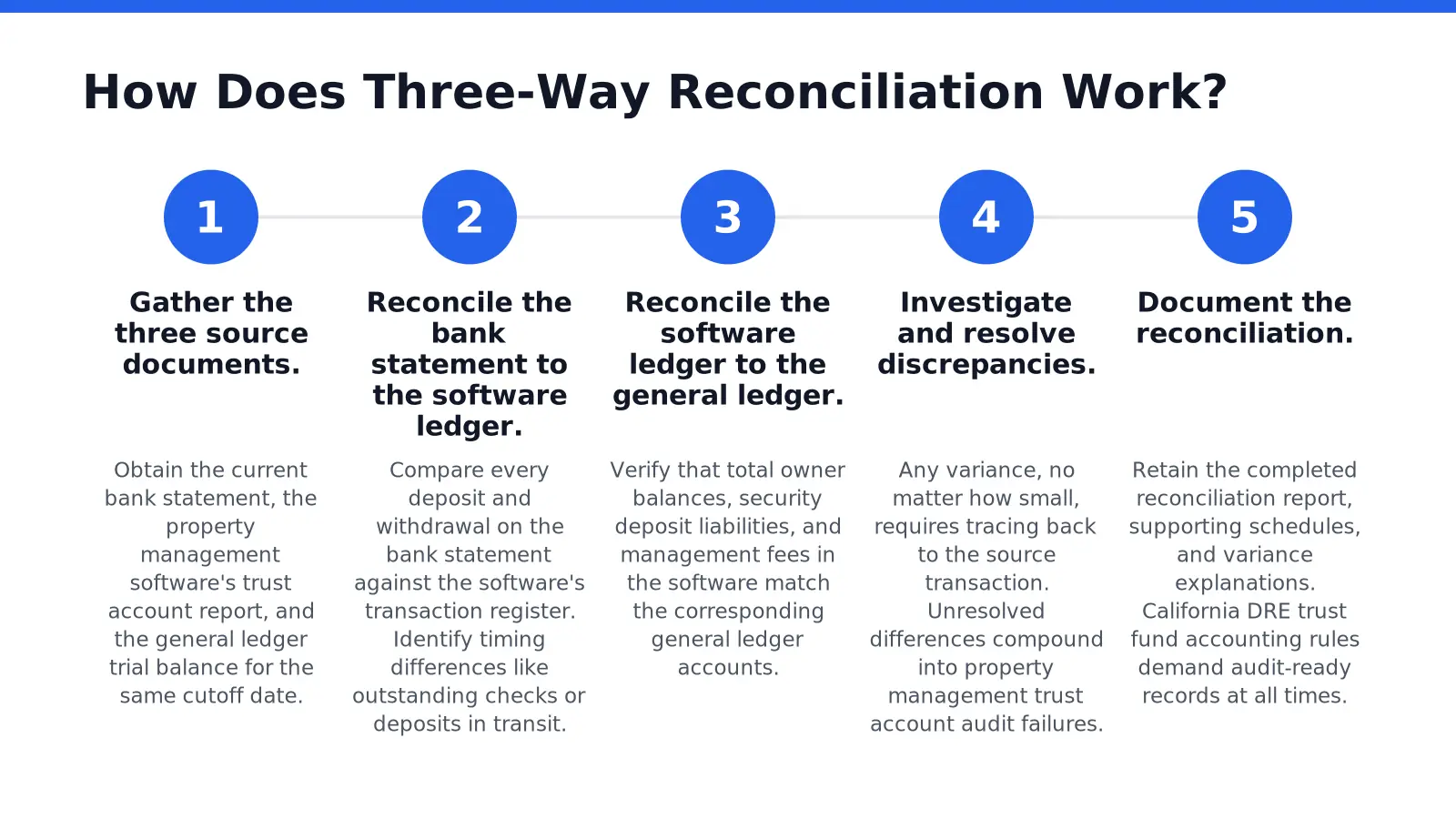
- Gather the three source documents. Obtain the current bank statement, the property management software’s trust account report, and the general ledger trial balance for the same cutoff date.
- Reconcile the bank statement to the software ledger. Compare every deposit and withdrawal on the bank statement against the software’s transaction register. Identify timing differences like outstanding checks or deposits in transit.
- Reconcile the software ledger to the general ledger. Verify that total owner balances, security deposit liabilities, and management fees in the software match the corresponding general ledger accounts.
- Investigate and resolve discrepancies. Any variance, no matter how small, requires tracing back to the source transaction. Unresolved differences compound into property management trust account audit failures.
- Document the reconciliation. Retain the completed reconciliation report, supporting schedules, and variance explanations. California DRE trust fund accounting rules demand audit-ready records at all times.
Reconciling multiple bank accounts against the property management software and general ledger simultaneously prevents the drift that triggers regulatory scrutiny.
What Are the Prerequisites for Trust Account Compliance?
Property managers in California must establish specific operational and financial foundations before trust account compliance becomes achievable. California trust fund accounting demands strict separation of client funds, specialized bookkeeping protocols, and documented reconciliation procedures that general accounting simply does not address. Without these prerequisites, property managers risk license suspension, owner lawsuits, and audit failures.
What Documentation Must a California Property Manager Maintain Before Opening a Trust Account?
The California Department of Real Estate (DRE) requires property managers to maintain a written authorization from each property owner before depositing funds into a trust account. This authorization specifies which funds the manager may hold and under what conditions disbursements occur. Managers also need a federally insured account designated exclusively for client money, never commingled with operating capital.
How Does Three-Way Reconciliation Support Audit Readiness?
Three-way reconciliation compares the trust account bank balance, the general ledger, and individual owner or tenant ledgers to confirm every dollar matches across all records. This process identifies discrepancies before they compound into compliance violations. A property management trust account audit examines these reconciliations for accuracy, timeliness, and completeness. Firms that skip monthly three-way reconciliation often discover unreconciled differences only when regulators arrive.
Property management bookkeeping adds layers of legal compliance, trust fund separation, and multi-entity reporting that a typical bookkeeper or CPA is not trained to handle. California DRE trust fund accounting rules govern deposit deadlines, record retention periods, and reconciliation frequency. OJO Bookkeeping operates as a fully virtual firm serving property management companies across the United States. The company manages $148.5 million in monthly expenses and 110,000 units, applying specialized workflows that keep trust accounts audit-ready. Cleanup and software setup services cost $45 per hour, while ongoing bookkeeping runs $34 per hour with no contract requirement.
How to Perform a Property Management Trust Account Audit?
A property management trust account audit verifies that client funds remain separate, documented, and accounted for down to the cent. California property managers face strict oversight from the Department of Real Estate, making audit preparation a continuous obligation rather than an annual scramble.
More properties mean more client funds, transactions, and deadlines to keep straight. Each additional unit multiplies the opportunities for a missed step to surface during an audit. A portfolio of 20 or more properties commonly produces audit findings tied to deposit timing, commingling, or incomplete reconciliation trails.
What Are the Steps in a Trust Account Audit?
- Reconcile the bank statement against the ledger. Match every transaction in the trust account to a corresponding entry in the property management software. Discrepancies signal missing deposits or unauthorized withdrawals.
- Verify tenant security deposit balances. Compare each tenant’s ledger balance to the actual funds held. Shortfalls indicate funds were used improperly.
- Confirm owner disbursement accuracy. Review every owner draw against the management agreement and supporting invoices. Overpayments or undocumented fees create immediate audit exceptions.
- Test deposit timing compliance. California law requires prompt deposit of trust funds. Delayed deposits are a frequent finding for managers handling 20 or more properties.
- Document the three-way reconciliation. The bank balance, the ledger balance, and the sum of individual owner and tenant balances must agree exactly.
What Does a California DRE Trust Fund Accounting Audit Examine?
The California Department of Real Estate audits trust accounts for separation of funds, accurate recordkeeping, and timely reconciliation. California DRE trust fund accounting rules require that client money never mixes with operating capital. Auditors also review whether security deposits remain untouched except for lawful deductions.
How Often Should Property Managers Audit Their Trust Accounts?
Monthly internal audits prevent small errors from compounding into license-threatening violations. Quarterly external reviews add an independent verification layer. OJO Bookkeeping employs 200+ bookkeeping professionals, auditors, and supervisors who maintain audit-ready records for California property managers.
What Are Common Trust Accounting Mistakes in California?
California property managers face strict trust accounting rules. The most damaging mistakes stem from commingling funds, missing reconciliation deadlines, and failing to document every transaction. These errors trigger audits, fines, and license revocation by the California Department of Real Estate (DRE).
California trust fund accounting demands absolute separation of client money from business operating funds. Commingling occurs when a property manager deposits rent, security deposits, or maintenance reserves into the company’s general operating account. This single act violates DRE regulations immediately. DoorLoop’s 2026 guide on property management trust accounting states the rule plainly: separation is mandatory. Never mix business operating funds with client funds.
The consequences extend beyond regulatory penalties. Many landlords do not know how their management company handles funds behind the scenes, according to Green Oak Property Management’s September 2026 trust accounting guide. When an owner discovers commingled accounts, the relationship ends. Lawsuits follow.
Why Does Commingling Happen So Often in California?
Rapid portfolio growth creates pressure to cut corners. A manager adding ten properties in a quarter might delay opening new trust sub-accounts. That delay becomes a violation. OJO Bookkeeping’s founder, Owen Jones, started as a property manager and built the firm to address these exact pain points. The company’s virtual bookkeeping team prevents commingling through automated fund segregation across AppFolio, Buildium, and RentVine integrations.
What Makes Three-Way Reconciliation a Common Failure Point?
Three-way reconciliation matches the bank statement, the general ledger, and individual owner or tenant ledgers. A single discrepancy in any ledger breaks the reconciliation. Property managers handling dozens of transactions monthly often skip this step when time runs short. The DRE audits catch skipped reconciliations quickly. Missing even one month’s three-way match signals deeper recordkeeping failures to an auditor.
California DRE trust fund accounting rules also require strict record retention. Destroyed or missing records during a property management trust account audit create an assumption of wrongdoing. Auditors treat absent documentation the same as missing funds. The compliance issues and legal pitfalls vary by state, but California’s enforcement ranks among the nation’s strictest. A single commingling incident or reconciliation gap puts a broker’s license at immediate risk.
How Often Must You Reconcile Trust Accounts?
Trust account compliance runs on three separate rules. Deposit timing, reconciliation frequency, and record retention each carry distinct deadlines. Property managers handling California trust fund accounting face strict expectations for how often books must balance against bank statements.
Monthly reconciliation is the standard. The California Department of Real Estate (DRE) requires property managers to perform three-way reconciliation every month. This process matches the trust account bank statement, the general ledger, and individual client sub-ledgers. Any discrepancy signals a problem that demands immediate correction.
What Does a Monthly Reconciliation Actually Involve?
The process follows a clear sequence. Each step builds on the previous one.
- Obtain the month-end bank statement for every trust account.
- Compare the statement’s ending balance to the general ledger balance.
- Reconcile each client’s sub-ledger to the general ledger totals.
- Investigate and resolve any unmatched transactions immediately.
- Document the completed reconciliation with a signature and date.
Skipping a month creates compounding errors. A small oversight in January becomes a major liability by March. California DRE trust fund accounting rules treat reconciliation lapses as serious compliance failures.
What Happens During a Property Management Trust Account Audit?
A property management trust account audit examines reconciliation records first. Auditors from the DRE check for consistent monthly reconciliations. Gaps in the record trigger deeper investigation. The audit verifies that client funds remained segregated from operating capital at all times.
Ongoing monthly reconciliation protects against these risks. OJO Bookkeeping provides dedicated bookkeeper support for this recurring task. When properly set up, tenant funds stay safe and the firm remains protected against judgments and audits. The paper trail proves compliance long after individual transactions fade from memory.
What Happens If You Fail a DRE Trust Fund Audit?
Failing a California DRE trust fund accounting audit carries severe consequences for property managers. Mishandling trust funds is one of the fastest ways to destroy an owner’s trust, trigger a lawsuit, or lose a broker’s license entirely. A failed property management trust account audit also exposes a manager to state audit escalation, license suspension, or worse.
The California Department of Real Estate treats trust fund violations as serious disciplinary matters. A single missed step in reconciliation or recordkeeping can cascade into formal enforcement action.
What Are the Immediate Consequences of a Failed Audit?
- License suspension or revocation. The DRE can suspend a broker’s license pending investigation.
- Civil lawsuits. Owners and tenants can sue for misappropriated or unaccounted funds.
- State audit escalation. A failed audit triggers deeper scrutiny of all managed properties.
How Can Property Managers Avoid These Outcomes?
OJO Bookkeeping manages 110,000 units and provides audit-ready recordkeeping for property managers across California. The company’s three-way reconciliation process aligns bank statements, trust ledgers, and owner statements before discrepancies reach the DRE’s attention. Property managers who maintain this discipline reduce their exposure to enforcement actions and preserve their operating authority.
FAQ
What is three-way reconciliation in California trust fund accounting?
Three-way reconciliation matches the bank statement, the property management software ledger, and the general ledger to the cent. California property managers must perform this monthly.
What does the California DRE require for trust accounts?
Property managers must keep a complete paper trail proving every transaction for a specified period.
What happens if a property manager fails a DRE trust account audit?
Failure to produce a three-way reconciliation on demand signals deeper compliance failures. The DRE treats unreconciled trust accounts as evidence of potential misappropriation, leading to license suspension and mandatory restitution.
Conclusion
California property managers who treat monthly three-way reconciliation as optional invite license suspension and legal exposure. The DRE audits reconciliation records first, and gaps signal deeper failures. Maintaining audit-ready trust accounting protects operating authority and preserves owner relationships. The choice is straightforward: reconcile every month or face enforcement consequences.